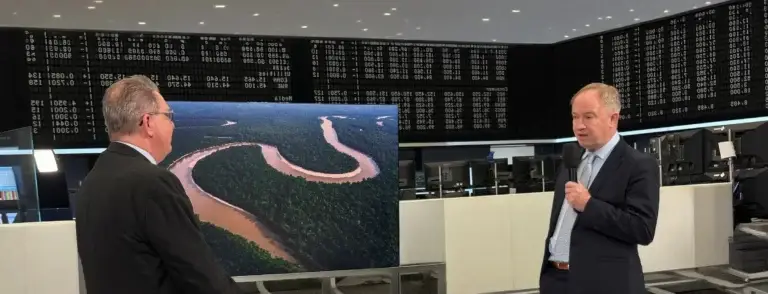

Investors and financial professionals seek stable, high-return opportunities in uncertain macroeconomic environment. Microfinance—often overlooked as a niche sector—is proving to be an asset class with compelling tangible benefits. At our recent guest lecture with Professor Maurizio Dallocchio from Bocconi University, we explored the potential of microfinance investments, their resilience in unpredictable markets and their material societal impact.
Hosted across Zürich and Milan, the sessions brought together financial experts, investors and academics to discuss micro funding as an emerging asset class. The discussion once again underscored why microfinance is no longer just a tool for social good. Research conducted by the Bocconi University’s School of Management, confirms that microfinance is a financial instrument with consistent returns, low correlation to traditional markets and sustainable impact.
Microfinance has evolved beyond small loans for entrepreneurs and now represents a structured, investable asset class with clear financial benefits. Studies demonstrate the consistent positive returns and low volatility of microfinance funds. A Monte Carlo simulation further reinforced the reliability of microfinance investments, showing that in most scenarios, these funds deliver positive returns.
In an era where traditional financial markets face instability due to inflation, geopolitical risks and shifting monetary policies, microfinance stands out as a resilient investment. Its independence from mainstream financial markets allows it to act as a hedge against macroeconomic fluctuations, making it an attractive option for investors seeking stability.
At Mikro Kapital Management, we play a pivotal role in financing small and medium-sized entrepreneurs in emerging markets. By providing loans to underserved communities, we empower local businesses, foster economic development, and drive financial inclusion. All while delivering positive returns.
Beyond capital, we equip entrepreneurs with essential financial literacy and business management training, ensuring that their businesses grow sustainably. This approach aligns with the United Nations Sustainable Development Goals (SDGs) by reducing inequality, promoting decent work and economic growth and fostering innovation at the grassroots level.
To illustrate the tangible impact of microfinance, let’s consider a real-life example from one of our clients in Tajikistan:
“I acquired this 20×6×4-metre greenhouse for around US$7,000 in February 2024. I planted 500 tomato saplings, each projected to yield 20 kilos. Selling at approximately US$1 per kilo, the first harvest alone could generate US$10,000.”
This example is a testament to how microfinance empowers entrepreneurs to scale their businesses, increase their income and contribute to local economies all while delivering high yields. Such examples highlight the direct link between financial inclusion and economic resilience.
Microfinance is more than just a financial instrument. It is a catalyst for economic transformation offering:
- Competitive risk-adjusted returns,
- Portfolio diversification,
- Alignment with ESG and impact investing goals.
As we continue exploring the full potential of this asset class, we invite you to join the conversation. Whether you are an investor, a financial professional or an advocate for economic inclusion, microfinance presents a unique opportunity to generate both financial and social returns. Get in touch with us to learn more about this asset class.
About ALTERNATIVE portfolio companies: ALTERNATIVE portfolio companies connect investors with high-impact opportunities across emerging markets worldwide. By combining traditional alternative finance with blockchain innovation, ALTERNATIVE portfolio companies provide entrepreneurs with flexible financing solutions whilst offering investors visibility into their impact. ALTERNATIVE portfolio companies’ mission is to unlock potential, nurture entrepreneurial aspirations, and connect ambition with investment through innovative financial technology. ALTERNATIVE is a Luxembourg-based securitisation fund managed by MK Global Kapital Sàrl. For more information, please visit: www.mkglobalkapital.com. For media inquiries and interview opportunities, please contact [email protected]